Now would have ever guessed that Ronald Reagan would say this in an address to the nation:
"Under our new tax proposal the oil and gas industry will be asked to pick up a larger share of the national tax burden. The old oil depletion allowance will be dropped from the tax code except for wells producing less than 10 barrels a day. By eliminating this special preference, we'll go a long way toward ensuring that those that earn their wealth in the oil industry will be subject to the same taxes as the rest of us. This is only fair. To continue our drive for energy independence, the current treatment of the costs of exploring and drilling for new oil will be maintained."
- Ronald Reagan, May 28th 1985
................................................................................................................................................................
The oil depletion allowance is a tax gimmick instituted in 1926 that allows well owners to deduct a fraction of their revenues rather than their actual costs. Of course, they can chose to do the latter if it works out better, so effectively this becomes a tax cut relative to standard accounting...in many cases a very large one. There is no reason to grant a sweetheart deal to the world's most profitable industry. Reagan was right, and this tax break should be eliminated.
Saturday, November 15, 2014

Monday, September 29, 2014
Statistical Lives - Volcanic Edition
First, I would like to thank all the people that expressed concern about me last weekend. As most of my friends know, my hobby is climbing mountains and I live in Japan. If I hadn't been at a wedding last Saturday, I would have been climbing somewhere on such a beautiful fall day, and Ontake is certainly on the list. Fortune was with me that day, but tragically not for at least 36 others.
That being said, climbing here or almost anywhere at those elevations in the summer or fall is not particularly risky. In fact, my back-of-the-envelope calculations put my chances of dying on the mountain - whether due to volcanic activity or more mundane things like falls, landslides, or exposure - is about the same as the risk I incur driving to the mountain trailheads. More importantly, the combination of all these risks are dwarfed by the exercise benefits.

In short, the approximately half of a statistical life-day I "lost" due to various risks of this hobby are much smaller than the approximately four statistical life-days I "gained" due to the incredible amount of exercise each of these climbs bring. Even if the exercise didn't have this benefit, I'd be perfectly happy to give up a half day of my life if it meant eleven of them were so pleasurable. So while I appreciate your concern, just keep things in perspective - climbing is about as dangerous as a long Sunday drive, and the exercise will help ensure that I stick around to pester you with blog posts for a long, long time.
Oh, and here is Why I Climb. Need I say more?


asfadf

--------------------------------------------------------------------------------------------------------------------------
2: Volcanoes have killed about one hiker per year in Japan historically. Given that there are something like 75 climbable active volcanoes, and what appears to be a couple hundred people climb them per day throughout their 4-6 month seasons, something like 2-3 million climbs are made per year. My one-in-a-million estimate is probably high
3: This is based on my best efforts to track hiking deaths both in Japan and the US, adjusting for the difficulty of my climbs
4: Based on a study by the National Cancer Institute found here: 2.5 hours of moderate exercise or 1.25 hours of vigorous exercise per week increases your lifespan by 3.4 years, or 4.2 if you double up on the exercise. I assume I am already in the "double up" phase, and thus gain 0.8 years for each 2.5/1.25 hours. I also assume that only two-thirds of the exercise I get while climbing is additional, as I probably would have gotten some exercise (but not 6+ hours!) on those days.
That being said, climbing here or almost anywhere at those elevations in the summer or fall is not particularly risky. In fact, my back-of-the-envelope calculations put my chances of dying on the mountain - whether due to volcanic activity or more mundane things like falls, landslides, or exposure - is about the same as the risk I incur driving to the mountain trailheads. More importantly, the combination of all these risks are dwarfed by the exercise benefits.
In short, the approximately half of a statistical life-day I "lost" due to various risks of this hobby are much smaller than the approximately four statistical life-days I "gained" due to the incredible amount of exercise each of these climbs bring. Even if the exercise didn't have this benefit, I'd be perfectly happy to give up a half day of my life if it meant eleven of them were so pleasurable. So while I appreciate your concern, just keep things in perspective - climbing is about as dangerous as a long Sunday drive, and the exercise will help ensure that I stick around to pester you with blog posts for a long, long time.
Oh, and here is Why I Climb. Need I say more?
Ash crater of Adatara-san (Fukushima)
Skies Under Iwate-San (Iwate)
Hakkoda-san in Green (Aomori)
Crater Lake at Zao (Miyagi/Yamagata)
asfadf
Top of Japan: Mt Fuji (Yamanashi/Shizuoka)
--------------------------------------------------------------------------------------------------------------------------
1: Assumes 1 fatality per 150 million mile driven. This is about half the US rate, but since this hobby does not involve much driving at night or any while drunk, my odds are better
2: Volcanoes have killed about one hiker per year in Japan historically. Given that there are something like 75 climbable active volcanoes, and what appears to be a couple hundred people climb them per day throughout their 4-6 month seasons, something like 2-3 million climbs are made per year. My one-in-a-million estimate is probably high
3: This is based on my best efforts to track hiking deaths both in Japan and the US, adjusting for the difficulty of my climbs
4: Based on a study by the National Cancer Institute found here: 2.5 hours of moderate exercise or 1.25 hours of vigorous exercise per week increases your lifespan by 3.4 years, or 4.2 if you double up on the exercise. I assume I am already in the "double up" phase, and thus gain 0.8 years for each 2.5/1.25 hours. I also assume that only two-thirds of the exercise I get while climbing is additional, as I probably would have gotten some exercise (but not 6+ hours!) on those days.
Sunday, September 28, 2014
God Bless America, Ohio Secretary of State Edition
Summer 2009: I move to Ohio. Shortly after my move, I head off to the BMV to get my driver's license, set up my address, register to vote, etc
October 2010: I head online to see where I am supposed to vote in the upcoming elections. Answer? Nowhere, because Ohio somehow failed to register me the year before, and it was now a couple days past the deadline. Yet Michigan had already unregistered me. What the heck? Anyway, after a couple of phone calls it was clear I was disenfranchised for this cycle. But at least I was finally properly registered!
July 2011: I move overseas, but maintain my Ohio voting privileges. This requires sending in a form called an FPCA in order to enroll in the Ohio overseas voter / military system. The ballot is emailed to me, I print it, fill it out, sign it, and send it back, along with some other documentation like a copy of my driver's license.
October 2012: I send in my first overseas ballot, carefully following the instructions.
Summer, 2013: My parents receive a letter stating I am being purged from the Ohio voter rolls for living with them in Michigan. Oh, and apparently I didn't vote in 2012. Even though I did. It appears my vote was tossed for unknown reasons. A letter exchange with Cuyahoga county solved the registration issue, but of course not the lost vote, which will forever remain a mystery.
September 2014: It now appears I have been booted from the overseas voter system, probably during the failed purge, and have to reapply. Fortunately, I caught this issue with a week to spare and will be sending in my new FPCA (along with a nasty note) in short order.
Anyone want to bet that Ohio will find a way to disenfranchise me a third time?
October 2010: I head online to see where I am supposed to vote in the upcoming elections. Answer? Nowhere, because Ohio somehow failed to register me the year before, and it was now a couple days past the deadline. Yet Michigan had already unregistered me. What the heck? Anyway, after a couple of phone calls it was clear I was disenfranchised for this cycle. But at least I was finally properly registered!
July 2011: I move overseas, but maintain my Ohio voting privileges. This requires sending in a form called an FPCA in order to enroll in the Ohio overseas voter / military system. The ballot is emailed to me, I print it, fill it out, sign it, and send it back, along with some other documentation like a copy of my driver's license.
October 2012: I send in my first overseas ballot, carefully following the instructions.
Summer, 2013: My parents receive a letter stating I am being purged from the Ohio voter rolls for living with them in Michigan. Oh, and apparently I didn't vote in 2012. Even though I did. It appears my vote was tossed for unknown reasons. A letter exchange with Cuyahoga county solved the registration issue, but of course not the lost vote, which will forever remain a mystery.
September 2014: It now appears I have been booted from the overseas voter system, probably during the failed purge, and have to reapply. Fortunately, I caught this issue with a week to spare and will be sending in my new FPCA (along with a nasty note) in short order.
Anyone want to bet that Ohio will find a way to disenfranchise me a third time?
Saturday, September 6, 2014
Swimming Pools Good, Guns Bad
A number of gun advocates use bad statistics and logic to conclude that
swimming pools are more dangerous than guns. They make a number of
logical mistakes, such as only looking at accidental shootings or
focusing on children and thereby deliberately ignoring the adults who are much
more likely to be shot and less likely to drown in a swimming pool.
Leaving those arguments aside, however, there is another reason they are
fundamentally wrong – the health benefits of a swimming pool dwarf the
risks, providing around an order of magnitude more lifespan increase via
exercise than they claim due to drowning accidents, if not more.
390 children per year under the age of 15 drowned in the nation’s approximately 10.7 million swimming pools between 2009 and 2012. Note that this data is substantially different that the data from 1997 used in the Levitt article cited above (550, 6 million), so we clearly have experienced a dramatically falling death rate the last 15-20 years. I suspect you can blame regulations for that. In any case, data on teens or adults is sparse but the trend of death rates falling rapidly with age clearly continues, at least until very old age. Let's approximate it at 450 total drowning per year in recent years, which works out to one death per 23,778 pools.
Sadly, the average age of the drowning victims – two-thirds are between one and three years old – is very low, so let’s approximate the average as five years. Compared to an eighty year lifespan, this represents 75 years of lost life per 23,778 pools per year. Therefore, the average pool claims 1.15 life-days (or 28 life-hours) each year due to drownings.
So how does this stack up against the exercise benefits? In short, this risk is dwarfed by them. For example, this paper indicates (summary here), that meeting the CDC guidelines of 2.5 hours of moderate exercise (such as playing in a pool) per week extends lifespan by a whopping 3.4 years. If you work through the math on that, you will find that for each hour of moderate exercise, your lifespan is increasing by two hours and fifty minutes, almost three times as much! Vigorous exercise is even better, close to a six to one ratio. This data was specifically for those aged over 40, but it is highly likely that something similar applies to younger people as well.
So assuming that swimming in a residential pool meets the paper’s definition of moderate exercise, which is certainly seems to, and that the benefits of exercise are roughly constant with respect to age, then if a pool generates a mere 10.4 hours of additional moderate exercise per year, it will save more life-days than it will take. While I don’t have any firm data on how many person-hours a typical pool represents each year, surely it is far, far higher than 10.4, probably closer to several hundred, and many thousands for public pools. Clearly, the health benefits win in a landslide, and the net effect of owning a pool is to cause your family members to live substantially longer, not less.
So while pools are risky, they are far less risky than the alternative – your kids sitting around in front of the TV growing fat. Obviously, one should take the risks of pools seriously, follow all relevant regulations, and otherwise act prudently, but getting your kids a pool is ten steps forward for every one back.
In contrast, guns do not have any health benefits that would offset the incredible risks that they bring to bear on your family. To compare them to pools, which are a substantial net positive from a health and longevity perspective, is therefore completely mistaken. Guns do not lower your cholesterol, or prevent heart attacks, or make your sex life better. They just get you and your family members killed, both by dramatically increasing suicide rates in your home, and turning what would have been merely heated arguments into fatal tragedies. If you love your family, you'd sell your guns for scrap today, and use the money to buy a pool.

….
Addendum: The same logic works for cycling. Others have worked out the math here. Exercise is your friend, folks.
390 children per year under the age of 15 drowned in the nation’s approximately 10.7 million swimming pools between 2009 and 2012. Note that this data is substantially different that the data from 1997 used in the Levitt article cited above (550, 6 million), so we clearly have experienced a dramatically falling death rate the last 15-20 years. I suspect you can blame regulations for that. In any case, data on teens or adults is sparse but the trend of death rates falling rapidly with age clearly continues, at least until very old age. Let's approximate it at 450 total drowning per year in recent years, which works out to one death per 23,778 pools.
Sadly, the average age of the drowning victims – two-thirds are between one and three years old – is very low, so let’s approximate the average as five years. Compared to an eighty year lifespan, this represents 75 years of lost life per 23,778 pools per year. Therefore, the average pool claims 1.15 life-days (or 28 life-hours) each year due to drownings.
So how does this stack up against the exercise benefits? In short, this risk is dwarfed by them. For example, this paper indicates (summary here), that meeting the CDC guidelines of 2.5 hours of moderate exercise (such as playing in a pool) per week extends lifespan by a whopping 3.4 years. If you work through the math on that, you will find that for each hour of moderate exercise, your lifespan is increasing by two hours and fifty minutes, almost three times as much! Vigorous exercise is even better, close to a six to one ratio. This data was specifically for those aged over 40, but it is highly likely that something similar applies to younger people as well.
So assuming that swimming in a residential pool meets the paper’s definition of moderate exercise, which is certainly seems to, and that the benefits of exercise are roughly constant with respect to age, then if a pool generates a mere 10.4 hours of additional moderate exercise per year, it will save more life-days than it will take. While I don’t have any firm data on how many person-hours a typical pool represents each year, surely it is far, far higher than 10.4, probably closer to several hundred, and many thousands for public pools. Clearly, the health benefits win in a landslide, and the net effect of owning a pool is to cause your family members to live substantially longer, not less.
So while pools are risky, they are far less risky than the alternative – your kids sitting around in front of the TV growing fat. Obviously, one should take the risks of pools seriously, follow all relevant regulations, and otherwise act prudently, but getting your kids a pool is ten steps forward for every one back.
In contrast, guns do not have any health benefits that would offset the incredible risks that they bring to bear on your family. To compare them to pools, which are a substantial net positive from a health and longevity perspective, is therefore completely mistaken. Guns do not lower your cholesterol, or prevent heart attacks, or make your sex life better. They just get you and your family members killed, both by dramatically increasing suicide rates in your home, and turning what would have been merely heated arguments into fatal tragedies. If you love your family, you'd sell your guns for scrap today, and use the money to buy a pool.
….
Addendum: The same logic works for cycling. Others have worked out the math here. Exercise is your friend, folks.
Sunday, August 31, 2014
Long Live Peak Oil...
To anyone out there who says the peak oil theory is dead, please note the following:
1: The western hemisphere's largest infrastructure project is an off-shore oil project near Brazil with a projected cost of $237 billion. Yes, that is a "b".

2: That is more than three times the projected cost of the next largest project, the California High Speed Rail system, and almost as much as the US spends on all public infrastructure projects in one year.
3: According to one insider, the break-even cost on that oil is $110/barrel.
When the oil majors are already messing around with dregs like this, what are they going to be doing twenty years from now? Fifty? It ain't going to be pretty, whatever it is. We can either prepare for the inevitable production declines and price surges by carefully nursing our remaining oil reserves, or we can continue to drill-baby-drill until the collapse begins. Which policy is conservative, and which is insane? You decide.
1: The western hemisphere's largest infrastructure project is an off-shore oil project near Brazil with a projected cost of $237 billion. Yes, that is a "b".
2: That is more than three times the projected cost of the next largest project, the California High Speed Rail system, and almost as much as the US spends on all public infrastructure projects in one year.
3: According to one insider, the break-even cost on that oil is $110/barrel.
When the oil majors are already messing around with dregs like this, what are they going to be doing twenty years from now? Fifty? It ain't going to be pretty, whatever it is. We can either prepare for the inevitable production declines and price surges by carefully nursing our remaining oil reserves, or we can continue to drill-baby-drill until the collapse begins. Which policy is conservative, and which is insane? You decide.
Snatching Defeat on Immigration
Congratulations, President Obama and my fellow Democrats. You have managed to turn a winning issue for our party - immigration - into a losing one. Poll after poll is showing strong opposition to the President's policies with respect to the immigration issue.
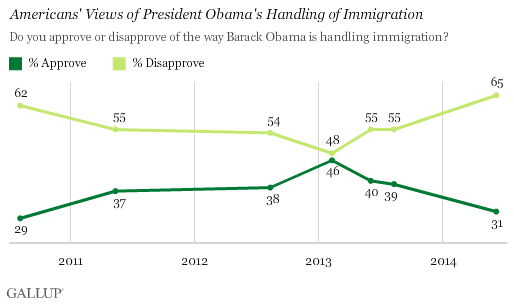 It has gotten so bad that the majority of Americans want less legal immigration, and independents have switch solidly into the Republican camp on this issue. How did Democrats screw this up so badly?
By betraying legal immigrants, and selling the farm on behalf of those who are in the US illegally. The Senate "Gang of Eight" bill has little for legal immigrants, and most of what might benefit them is offset by tens of billions of dollars of unfunded and wasteful security spending which will inevitably catch legal immigrants in its net. I especially love how they "solved" the problem of backlogs of up to twenty years for some visa types - not by speeding up the lines, but by eliminating those visa types completely! Brilliant!
What America needs is a full-throated, unabashed pro-legal-immigration party, a party that refutes the false and ugly claim (believed by 63% of Americans) that legal immigration harms the economy. Instead, we have an anti-immigration Republican party, and a Democratic party who only seems to care about securing another round of amnesty. Americans are siding with the former, and despite my extremely pro-immigration attitudes, I can certainly understand why. Hopefully my fellow liberals figure this out soon, or we are going to get hammered at the ballot box.
By betraying legal immigrants, and selling the farm on behalf of those who are in the US illegally. The Senate "Gang of Eight" bill has little for legal immigrants, and most of what might benefit them is offset by tens of billions of dollars of unfunded and wasteful security spending which will inevitably catch legal immigrants in its net. I especially love how they "solved" the problem of backlogs of up to twenty years for some visa types - not by speeding up the lines, but by eliminating those visa types completely! Brilliant!
What America needs is a full-throated, unabashed pro-legal-immigration party, a party that refutes the false and ugly claim (believed by 63% of Americans) that legal immigration harms the economy. Instead, we have an anti-immigration Republican party, and a Democratic party who only seems to care about securing another round of amnesty. Americans are siding with the former, and despite my extremely pro-immigration attitudes, I can certainly understand why. Hopefully my fellow liberals figure this out soon, or we are going to get hammered at the ballot box.
Saturday, August 30, 2014
Immigration and the Lump of Labor Fallacy
One very common (and bi-partisan!) argument I see against immigration is that it will lower wages of American workers. This meme is, fortunately, nonsense, as confirmed by numerous actual studies of real-world data. It is a classic example of what economists call the "Lump of Labor Fallacy" - the idea that there is a fixed pool of jobs, and if someone gets one, someone else does not. While this might be a sensible notion in one's very narrow experience, it is not true in the broader economy. If someone beats you out during the final interview round for a job, it is true that in the very short term, you are still out of work. However, the number of jobs in the economy does not decrease by one. Why? Because that someone will presumably spend their money from their new job, which will in turn create approximately one new job. If there were a million open positions across the US before the final interview round, there will still be a million the next day.
Immigration works the same way. Assuming for a moment that immigrants are more or less demographically matched to the native population in terms of education, age, etc, then any jobs they "take" will be made up for by the jobs they create when they spend their earnings. At first principle, this is a wash. In reality, immigrants are not demographically matched, so they can have impacts in specific labor markets where they are concentrated. If, for example, we were to allow a million dock workers to immigrate to the US, it is obvious that the wages of dock workers would fall. However, this would mean prices for goods passing through the docks would fall, which would in turn mean we'd all have a few more dollars in our pockets each month. When we spend this money, we'd create jobs all throughout the economy. How many? About as many as were lost by native dock workers! Likewise, the push to import a bunch of STEM workers will almost certainly depress wages for native STEM workers, but it means everyone else will be getting STEM products for cheap, saving us cash that we can then spend on other things. So while STEM workers have a right to complain, and may even deserve some sort of compensation or protection, overall, society wins.
If you can't see my point, let's try it another way. It should be obvious that population size of a country has essentially no impact on wages - there are plenty of counties of all sizes which are rich, and plenty which are poor. Therefore, to claim that immigration can lower wages is to claim that the economy somehow differentiates between population growth via border crossings and population growth via vagina crossings. That, of course, is absurd.
Immigration works the same way. Assuming for a moment that immigrants are more or less demographically matched to the native population in terms of education, age, etc, then any jobs they "take" will be made up for by the jobs they create when they spend their earnings. At first principle, this is a wash. In reality, immigrants are not demographically matched, so they can have impacts in specific labor markets where they are concentrated. If, for example, we were to allow a million dock workers to immigrate to the US, it is obvious that the wages of dock workers would fall. However, this would mean prices for goods passing through the docks would fall, which would in turn mean we'd all have a few more dollars in our pockets each month. When we spend this money, we'd create jobs all throughout the economy. How many? About as many as were lost by native dock workers! Likewise, the push to import a bunch of STEM workers will almost certainly depress wages for native STEM workers, but it means everyone else will be getting STEM products for cheap, saving us cash that we can then spend on other things. So while STEM workers have a right to complain, and may even deserve some sort of compensation or protection, overall, society wins.
If you can't see my point, let's try it another way. It should be obvious that population size of a country has essentially no impact on wages - there are plenty of counties of all sizes which are rich, and plenty which are poor. Therefore, to claim that immigration can lower wages is to claim that the economy somehow differentiates between population growth via border crossings and population growth via vagina crossings. That, of course, is absurd.
Subscribe to:
Posts (Atom)